At a glance
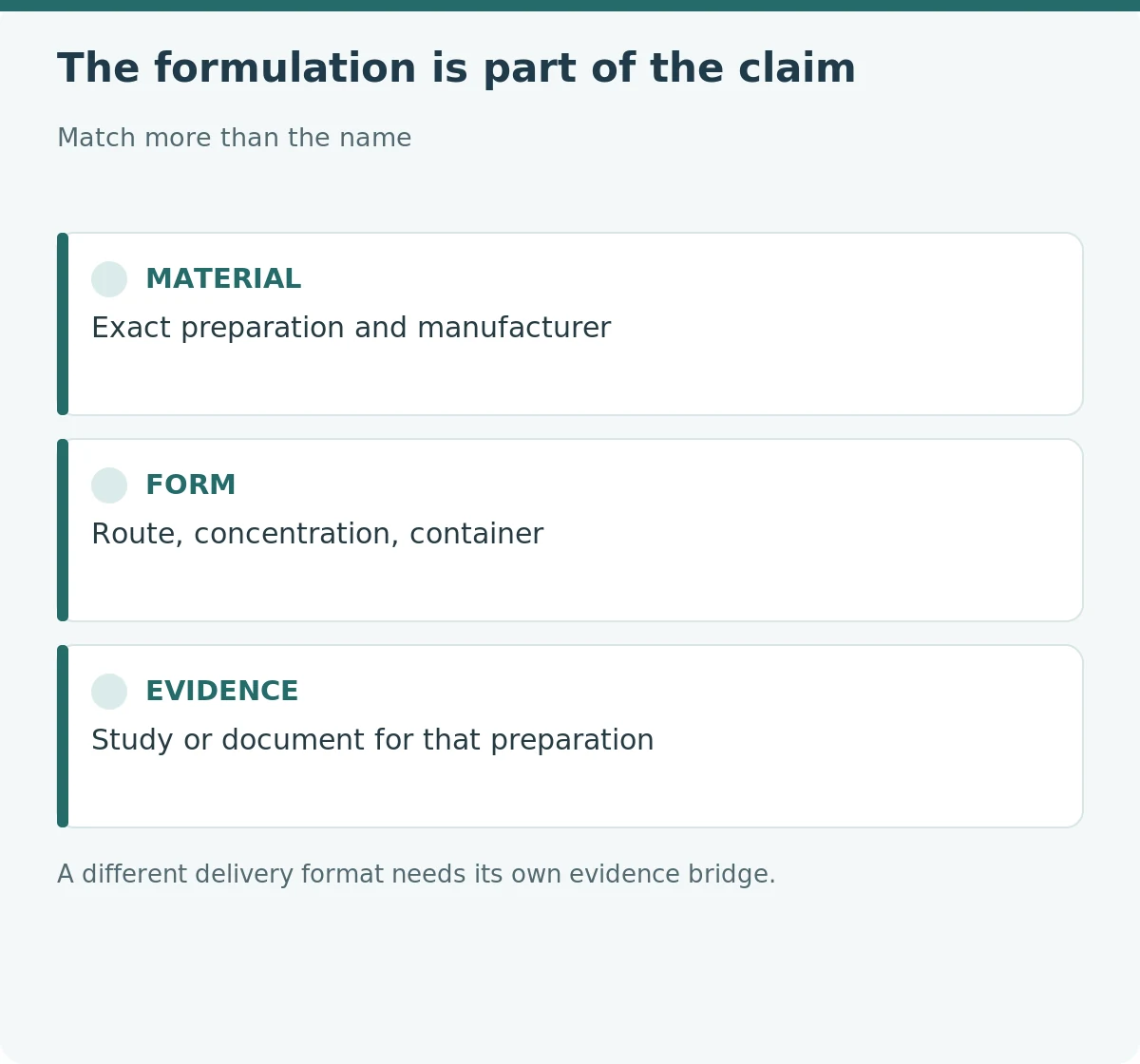
A product called Cerebrolysin should be matched to the actual preparation used in the evidence. An injectable medicinal product, a nasal listing, an oral product, and a powder described with similar words are not automatically equivalent. Product form changes the question about identity and delivery; a shared name does not supply the missing research.
In this guide
- Start with the preparation, not the packaging style
- Why route is part of the evidence
- How to assess an oral or nasal claim
- Concentration and total quantity answer different questions
- Read the document scope as carefully as the result
- A worksheet for two descriptions
- Choose clarity over convenience claims
Start with the preparation, not the packaging style
The manufacturer's product description identifies a solution for injection. That gives a concrete reference point when reading listings. It does not mean every item using the name is the same preparation, or that a different route can borrow the same clinical results.
Record the full product identity before looking at convenience claims. A glass ampoule, a multidose vial, a spray bottle, and a capsule are containers or dosage forms, not evidence of equivalence. The main guide explains the difference between a named preparation and a generic peptide category.
Why route is part of the evidence
A clinical intervention includes more than its ingredient name. The route, formulation, concentration, and conditions of administration help define what was tested. Changing them can alter the exposure being studied. A claim that the same amount appears on the label does not resolve those differences.
The manufacturer's administration information specifies injectable routes and immediate use after opening the ampoule. This is not a basis for inventing oral or nasal equivalents or reusing an opened container. The practical reading lesson is to preserve the route and handling context when linking a product to a study.
| Description | What to establish | What is not enough |
|---|---|---|
| Named injectable preparation | Manufacturer, exact formulation, route | A matching word in an advertisement |
| Nasal or oral listing | Formulation-specific identity and evidence | A paper using another route |
| Different container or concentration | What changed in the actual preparation | A convenience or strength claim |
| Laboratory report | Appropriate method and matching sample | An isolated purity percentage |
How to assess an oral or nasal claim
Ask for the exact formulation and the evidence for that route. A general paper about the original preparation is not a route-comparison study. A claim about absorption needs measurements relevant to the new formulation; a claim about clinical benefit needs a relevant outcome.
A listing may cite the biological plausibility of delivery while omitting the actual product comparison. Keep those stages separate. Plausibility can support further study, but it cannot establish that the product delivers the same exposure, has the same clinical effect, or shares the same safety profile.
The appropriate conclusion may simply be that the evidence provided does not establish equivalence. That is more precise than assuming either equivalence or total inactivity.
Concentration and total quantity answer different questions
A label may state a concentration per unit volume, a total volume per container, and a number of containers per pack. Those fields describe different quantities. An image of a large box or a large number on a label can distract from which field the number actually refers to.
Compare equivalent units only after the products themselves match. A claim that one format is more concentrated does not demonstrate a stronger clinical benefit. It changes a specification, and the clinical meaning of that specification requires separate evidence.
Our price guide shows how to keep pack arithmetic separate from clinical decisions. None of the calculations converts a study protocol into a personal-use plan.
Read the document scope as carefully as the result
A test for a raw ingredient may not describe the final preparation. A result for one batch may not describe another. A screenshot may omit the sample identity, method, or issuing laboratory. These gaps matter even when the number shown looks impressive.
Ask what the document actually measured and which sample it concerns. Do not treat a general chemical result as a complete assessment of every clinical or quality question. The COA guide helps separate identity, quantity, related substances, and microbiological testing.
For a complex preparation, simplistic comparisons with a single-peptide purity report can be especially misleading. The analytical method must be appropriate to the material rather than selected only because it produces an attractive percentage.
A worksheet for two descriptions
Place the official product description beside the proposed alternative. Compare the full name, manufacturer, ingredient statement, formulation, route, concentration, container, and evidence cited. Mark differences explicitly. Then ask which differences have supporting equivalence data and which remain assumptions.
This is a verification exercise, not a request for a seller to supply persuasive wording. A complete answer should point to relevant product-specific evidence. If the explanation returns repeatedly to unrelated papers about a different preparation, the gap has not been resolved.
Choose clarity over convenience claims
Convenience can matter, but it should be considered after identity, appropriate access, and evidence. An easier-looking format cannot erase the need to understand what is actually being supplied. Similarly, a familiar brand reference does not guarantee that the listing describes the studied preparation.
The strongest next step is to resolve one concrete discrepancy at a time. Use the buying guide for supplier and documentation questions, and return to the benefits article only when the product being discussed has been identified accurately.
Questions readers ask
Can a seller use the same study for a different route?
Only where the evidence supports the transfer being claimed. A study of one preparation does not automatically establish exposure, clinical benefit, or safety for another route.
Does a familiar package photograph verify the item?
No. It helps describe an offer but does not establish the supply chain or contents. The actual item, responsible supplier, and applicable documentation need to match.