At a glance
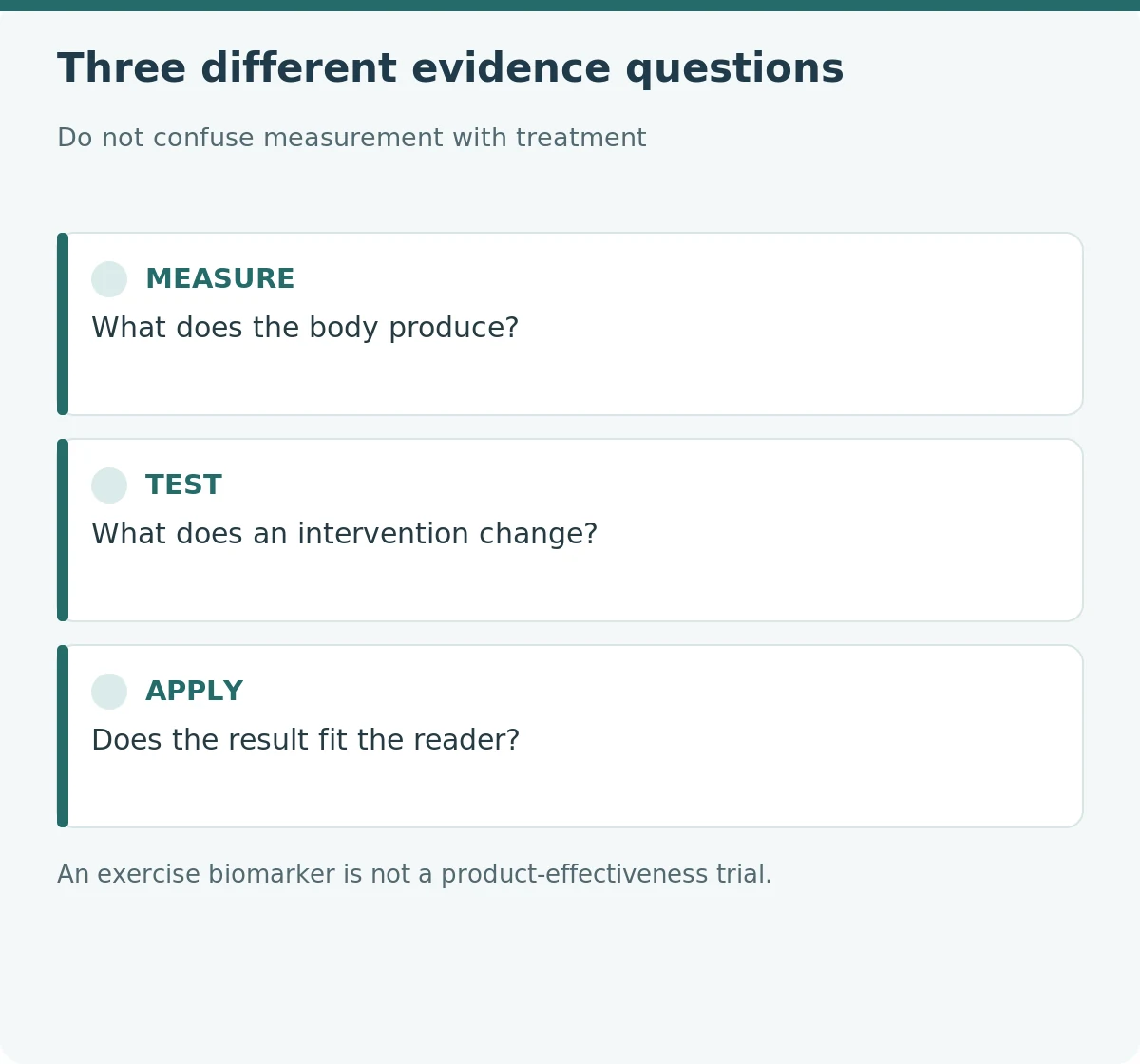
MOTS-c is discussed as a mitochondrial-derived peptide involved in metabolic signaling. Its research includes laboratory experiments, animal interventions, and measurements made in people during exercise. These are different kinds of evidence. A rise in a person's own MOTS-c during activity is not a trial showing that an externally supplied product treats fatigue or improves everyday energy.
In this guide
Why mitochondria appear in the conversation
Mitochondria are involved in cellular energy processes, which makes their signaling biology relevant to metabolism and exercise research. The word "mitochondrial," however, is not a clinical outcome. It does not identify the cause of a person's tiredness or prove that modifying one pathway will improve how they feel.
MOTS-c appears in this discussion because of a defined line of biological research. The useful task is to follow that research through its actual models and measurements rather than translate the mechanism straight into a wellness promise.
Separate administered peptide from the signal measured in the body
The original MOTS-c study investigated metabolic effects in experimental systems and mice. It also identified the peptide in biological samples. These observations helped establish a research direction, but they did not test a retail MOTS-c preparation as a treatment for general fatigue in humans.
A naturally occurring signal, a measurement of that signal, and an intervention that supplies a compound are three different things. Each can be scientifically interesting. Only the intervention question directly addresses what happens when a defined product is given under defined conditions.
| Type of MOTS-c evidence | Question it addresses | Question it does not answer alone |
|---|---|---|
| Laboratory experiment | How a pathway may respond | Whether adults feel less fatigued |
| Animal intervention | Effect in a defined experimental model | A consumer treatment effect in humans |
| Human exercise measurement | How endogenous signals change with activity | What a supplied product would do |
| Product analysis | What the listed tests show for a sample | Clinical effectiveness or every safety issue |
What exercise research adds
A human endurance-exercise study investigated circulating mitochondrial-derived peptides around an exercise intervention. That is useful evidence about the body's response to activity. It should not be presented as a placebo-controlled trial of injected MOTS-c.
When a page describes "human evidence," read the methods before assuming participants received the product. A study may have measured a biomarker, compared groups with different characteristics, or administered an intervention. Those designs answer different questions and support different conclusions.
The fatigue guide takes the next step: what outcomes and design would be needed to support a claim about feeling and functioning better?
Energy is not one measurement
Everyday language combines sleepiness, lack of motivation, exertional fatigue, muscle weakness, and difficulty concentrating under the heading "low energy." A study of one does not automatically answer the others. Even a measured improvement in exercise performance is not the same as a reduction in fatigue during ordinary daily life.
Define the experience before looking for a product. Is the issue staying awake, sustaining a task, recovering after activity, or feeling mentally clear? A clear definition makes it easier to judge whether an outcome in a paper is relevant. It also prevents the same vague claim from being used to sell very different interventions.
Why product labels do not settle the science
A vial, pen, or other format is a product presentation. It does not establish identity, content, clinical benefit, or the suitability of a particular route. Compare the exact material and documented tests before comparing the appearance of containers.
The format guide explains the difference between the labeled amount, concentration, and delivery device. The COA guide explains what a submitted sample's report can establish. Neither product documentation nor attractive packaging is a substitute for a relevant human study.
The same caution applies to related or modified research compounds. An analogue may have a different development record. Its findings should not be silently assigned to every product marketed as MOTS-c.
Read results and safety together
A result claim needs a baseline, a comparison, and a relevant measurement. A safety claim needs information about the exact preparation, the people exposed, the duration, and how unwanted events were monitored. Both questions remain important even when the biological mechanism is compelling.
The results guide explains before-and-after stories and timelines. The safety guide explains why unreported events and actively monitored outcomes are not the same thing. Reading them together prevents the choice from being framed only around possible benefits.
The next useful comparison
MOTS-c is often placed beside NAD+ or SS-31 because all three appear in mitochondrial or energy-related discussions. They are not the same kind of substance, and they need not address the same research question. A comparison should begin with identity and population rather than a universal ranking for energy.
Use the dedicated comparison pages when that is the decision you are trying to understand. The most productive conclusion may be that the available evidence concerns different populations and outcomes. That is still useful: it identifies exactly where a confident marketing comparison has outrun the data.
Questions readers ask
Does exercise increasing MOTS-c prove supplementation works?
No. Measuring a response to exercise and administering a product are different experiments. The intervention itself needs relevant evidence.
Is a mitochondrial mechanism enough to explain fatigue?
No. It can motivate research, but it does not identify the cause of a particular person's symptoms or establish an effective treatment for them.