At a glance
Cerebrolysin is a named injectable preparation studied in specific neurological conditions, not a single interchangeable wellness peptide. The most useful questions are which participants were studied, what improved, what other care they received, and whether a product description matches the preparation in that research. Evidence from neurological rehabilitation should not be rewritten as a promise of sharper thinking in healthy adults.
In this guide
What the name identifies
Online conversations often place Cerebrolysin beside individual compounds such as Semax or MOTS-c. That can make the names appear equivalent even though the products differ. The manufacturer's prescribing information identifies Cerebrolysin as a solution for injection and gives a particular composition and medicinal-product context.
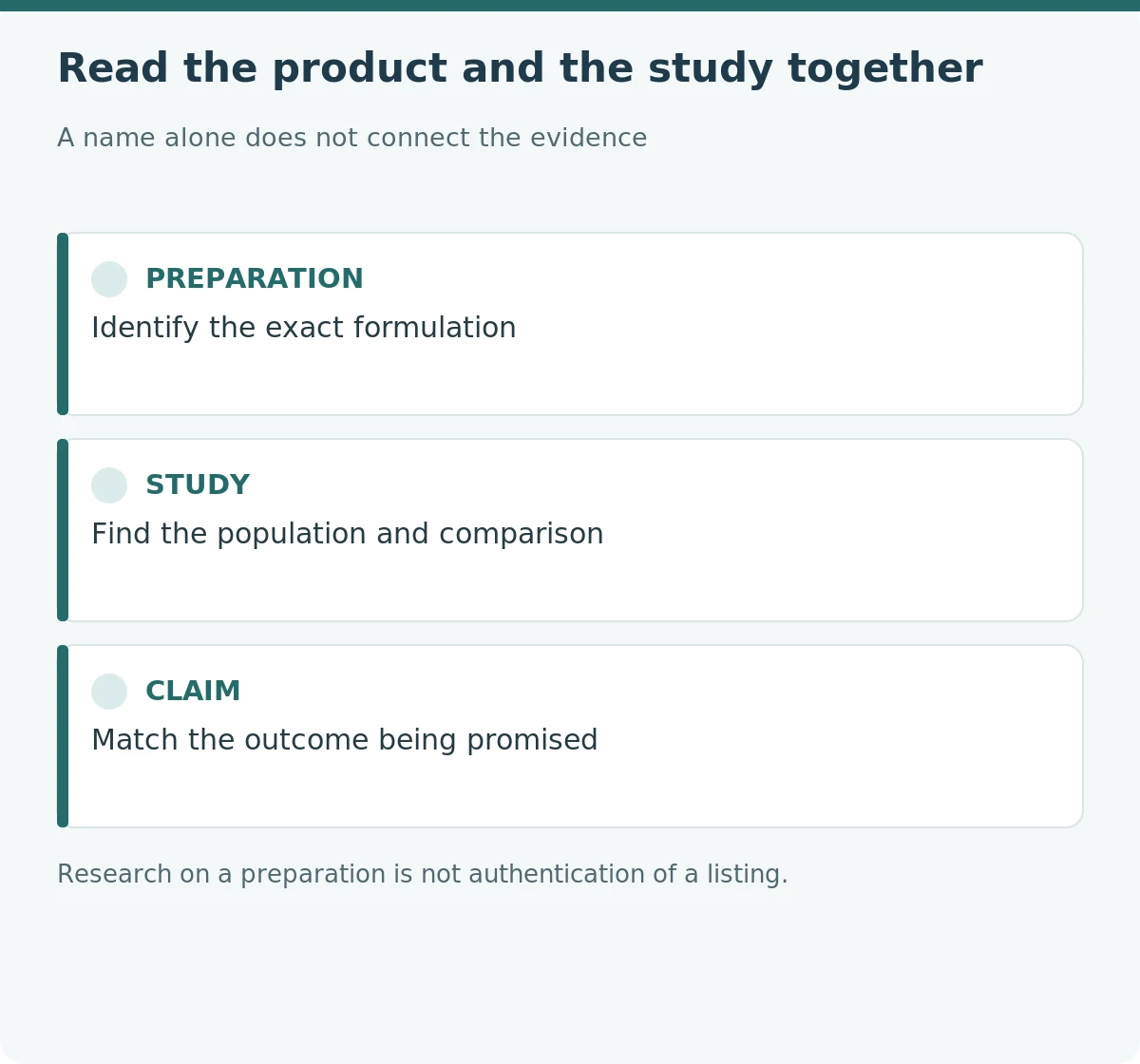
For readers, the practical consequence is that a similar-looking name is not enough. An unlabeled powder, an oral supplement, and a branded injectable product should not inherit each other's evidence. Start by matching the exact preparation. Our product-forms guide explains the details that need to agree before a paper can be applied to an offer.
Why it appears in neurological research
The clinical questions surrounding Cerebrolysin concern particular neurological illnesses and injuries. That is a narrower subject than general focus, emotional recovery, or energy. Even when a paper measures cognition, the meaning depends on the participants' starting condition and the test being used.
A result after a brain injury may reflect recovery of a function that was impaired. A claim about improving performance above a healthy baseline is a different question. The first cannot simply be substituted for the second. This is why the phrase "brain benefits" is less useful than identifying the particular task, symptom, or functional outcome.
| Question | Check first | Keep separate |
|---|---|---|
| What is the product? | Exact preparation and official description | A different product with similar wording |
| What benefit was measured? | Named outcome and study population | General brain-boosting language |
| What else happened? | Rehabilitation or other background care | The product acting alone |
| What is being offered? | Formulation, pack size, seller documentation | The existence of a research paper |
What a controlled rehabilitation study can tell you
In the CARS randomized trial, Cerebrolysin was evaluated alongside structured rehabilitation after stroke. The investigators reported an advantage on an upper-limb functional outcome and emphasized the exploratory nature of the study. That is evidence about an added intervention within a defined rehabilitation program, not about replacing rehabilitation.
The distinction matters when reading an advertisement that attributes every improvement to a product. Participants can receive several helpful components of care at once. A controlled design asks about the additional contribution of one component, while a testimonial may collapse the entire experience into a single explanation.
A useful summary therefore names the background care as well as the studied preparation. It also explains whether the assessment concerned an arm task, everyday independence, a memory scale, or another endpoint.
What common benefits claims leave out
Claims about memory, motivation, concentration, and neuroprotection are often grouped together, but they require different measurements. A laboratory account of cell survival does not tell a reader whether appointments became easier to remember. A clinical scale developed for a neurological illness does not necessarily describe everyday productivity.
Our benefits review divides the claims into separate questions. Read the outcome before reading the conclusion. Then ask whether the comparison was controlled, whether follow-up was long enough for the claim being made, and whether the article acknowledges conflicting findings.
A cautious conclusion is not the same as saying nothing was learned. A study can provide a meaningful signal for one condition while leaving a wider commercial claim unproven.
Safety belongs in the same conversation as benefit
The right safety question concerns an exact preparation and a specific person, not whether everyone on a discussion board had an uneventful experience. Clinical trials have entry criteria and monitoring arrangements. Those boundaries form part of the evidence and should remain visible when a result is summarized.
The safety guide explains adverse-event reporting, exclusions, and the difference between an event occurring during treatment and an event being caused by treatment. That distinction prevents two opposite mistakes: dismissing every reported problem or treating every coincidental problem as established causation.
Changing a route, combination, or product source introduces another uncertainty. A familiar name cannot remove it. Product-quality questions and the person's medical history need their own consideration.
How to read an online offer
An informative listing should make the full product identity, pack contents, formulation, seller, and relevant documentation understandable. Look for consistent descriptions across the listing, package, and official information rather than treating a photograph as authentication.
Quantity also needs a unit. The number of ampoules, their volume, and the concentration are separate fields. A low headline price may describe a smaller pack, and the total quoted cost may exclude services or other charges. The price-comparison article uses clearly hypothetical examples to show the arithmetic without pretending to quote a live market price.
A seller's inclusion of a scientific paper is a reference to research, not proof that the supplied product was used in that research. Keep the product check and the evidence check as two separate steps.
Choose the next article by the question you have
Start with the benefits page when you want to understand a particular claimed outcome. Use the reviews page when a personal story is doing most of the persuasive work. Use the formulation page when the same name appears on different product types. A comparison with Semax is useful only after the two identities and research settings are understood.
This sequence prevents a common research trap: moving among many product names while never resolving the original question. The strongest next step is the one that closes a specific information gap, whether that concerns a study, a personal report, or the actual item being described.
Questions readers ask
Is Cerebrolysin the same kind of product as a single peptide?
No. Treat the branded preparation as its own product identity. Evidence for one named preparation does not automatically apply to a separately marketed powder or a different formulation.
Do stroke results establish benefits for ordinary brain fog?
Not by themselves. The causes, starting function, study outcomes, and background care differ. A claim about brain fog needs evidence relevant to that population and question.