At a glance
Cerebrolysin benefits need to be assessed one claim at a time. A change in arm function after stroke, a cognitive-test result in dementia, and a claim about everyday motivation are different outcomes. Some clinical findings are encouraging, but they do not make every brain-related claim equally well supported. The useful question is which exact benefit a study tested and how closely it matches the reader's situation.
In this guide
- Start with a benefit that has a clear meaning
- Neurological recovery is not a universal finding
- Memory claims require attention to the population
- Motivation, mood, and productivity are separate claims
- Why effect size and follow-up matter
- Build a compact benefits record
- What a fair conclusion looks like
Start with a benefit that has a clear meaning
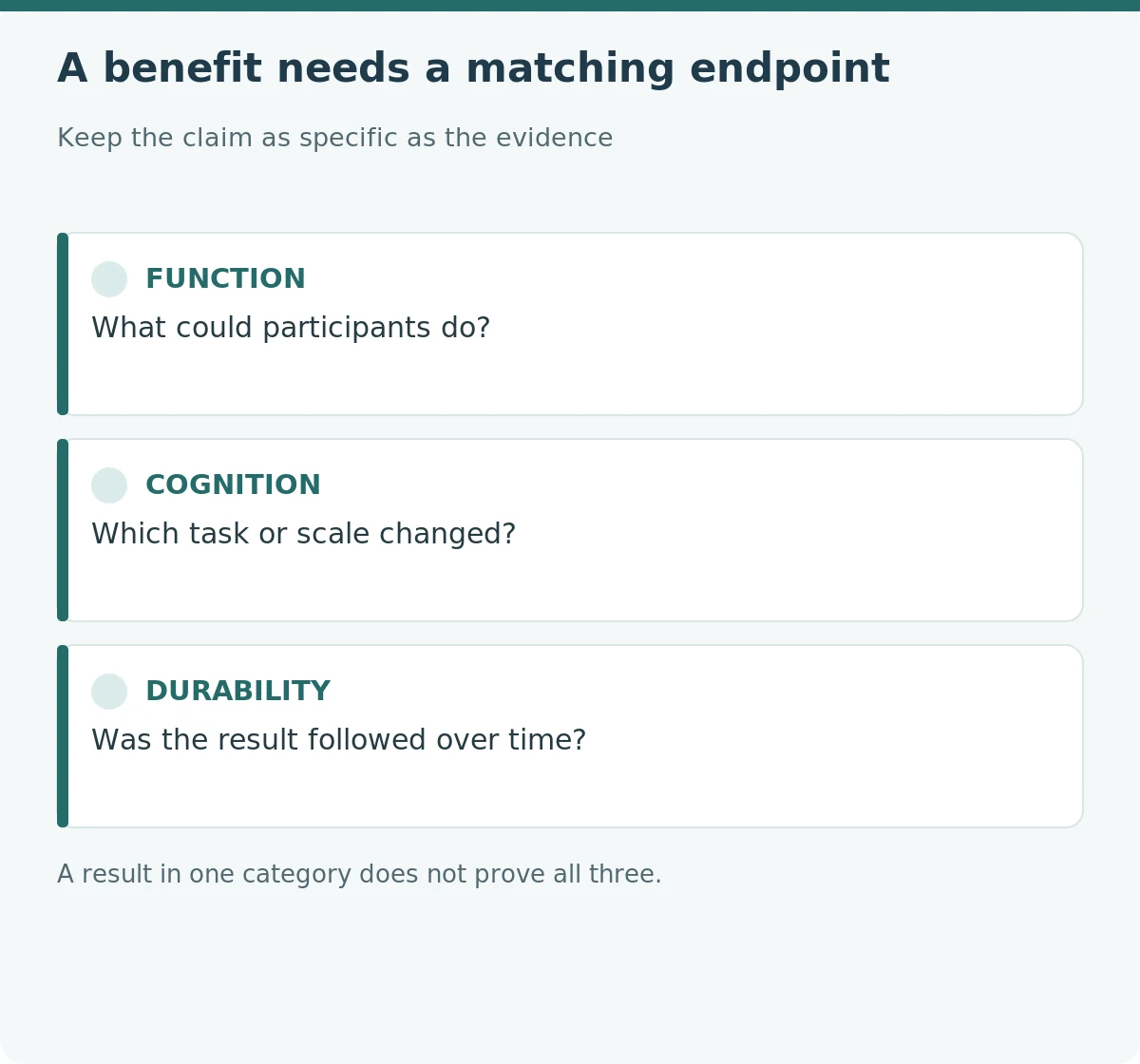
"Better brain health" is a broad aspiration, not a single clinical endpoint. A useful benefits page should translate it into something that can be measured: performance on a defined cognitive task, ability to complete an everyday activity, or improvement on a neurological scale. Each endpoint has its own limitations.
The same caution applies to "recovery." Someone may improve through a rehabilitation program without returning fully to their previous level of function. A scale change can still matter, but the reader needs to know what the scale describes. Our Cerebrolysin overview introduces these distinctions before the individual benefit claims.
Neurological recovery is not a universal finding
The large CASTA stroke trial did not show a statistically significant advantage on its main combined outcome in the overall study population. Exploratory signals in more severely affected participants cannot replace that primary result. A balanced account should not treat a favorable subgroup observation as if the main trial had proved a broad benefit.
This does not erase every other study. It means that study design, participant selection, background treatment, and the selected outcome may matter. When different trials produce different findings, the response is to explain the differences rather than build a benefits list from the positive phrases alone.
For a reader, the key distinction is between a prespecified test and an analysis explored after looking at the results. Both can inform research, but they provide different levels of confidence.
| Benefits claim | Evidence that would fit | Common overreach |
|---|---|---|
| Improved neurological function | A relevant functional outcome after a defined injury | Applying it to unrelated everyday symptoms |
| Improved cognition | A specified cognitive measure in a defined population | Promising sharper thinking for everyone |
| Lasting improvement | Follow-up after the treatment period | Calling an early result permanent |
| Better mood or motivation | Dedicated, controlled mood or function outcomes | Inferring it from any neurological improvement |
Memory claims require attention to the population
A randomized Alzheimer disease study evaluated repeated Cerebrolysin treatment using clinical measures in people with diagnosed disease. That context should stay attached to any discussion of cognitive results. It is not a trial of students, healthy professionals, or adults whose main concern is occasional forgetfulness.
A memory-related result also needs its scale. Remembering material on a structured test, managing daily tasks, and a caregiver's global impression can tell different parts of the story. When a promotional sentence simply says "improves memory," ask which of those outcomes it means.
The absence of a matching study is an unanswered question, not a reason to translate a disease-specific finding into an exact expectation for someone else.
Motivation, mood, and productivity are separate claims
A person who regains a practical ability may also feel more confident or engaged. That does not prove the intervention directly treats depression, increases motivation in healthy people, or improves work performance. Those interpretations need their own measurements and comparisons.
A useful benefits table therefore includes a column for what was not tested. A cognition study should not silently become a mood study. A neurological recovery scale should not silently become a productivity measure. This may leave some attractive claims without a definitive answer, but it makes the information considerably more useful.
Readers interested in a personal account can use the reviews guide to separate a worthwhile lived experience from an unsupported general prediction.
Why effect size and follow-up matter
A statistically detectable difference does not automatically describe a change that every person would notice. Ask how large the difference was, whether the measure has a meaningful clinical interpretation, and how much results varied. Group averages summarize a group; they do not guarantee an individual response.
The timing of assessment matters as well. A measurement made while treatment and rehabilitation are ongoing answers a different question from a later assessment. If the claim is that a benefit persists, there needs to be follow-up capable of addressing persistence.
Do not turn the final assessment day into an onset promise. A study that measures people at the end of a program does not necessarily establish the first day on which they felt or performed differently.
Build a compact benefits record
For each proposed benefit, record the population, the exact preparation, the comparison, the endpoint, and the main result. Add a final column for the question that remains. This small discipline makes it harder to overstate a finding and easier to notice when two pages are repeating the same paper.
Include unfavorable or inconclusive findings rather than keeping only results that support a preferred choice. A realistic view of uncertainty is useful when comparing a possible benefit with cost, treatment burden, and safety. Our safety article covers that other side of the decision.
What a fair conclusion looks like
A fair conclusion might say that a particular study supports further investigation of a defined neurological outcome, while another trial did not demonstrate an overall benefit on its primary endpoint. That is more accurate than calling the compound universally effective or universally useless.
For the reader, the practical outcome is a narrower question to bring into a clinical discussion: does the evidence concern the same condition, stage of recovery, preparation, and desired result? Once those are aligned, the remaining benefits question becomes much clearer. Product comparisons should follow that understanding rather than substitute for it.
Questions readers ask
Why can two Cerebrolysin articles reach different conclusions?
They may be discussing different conditions, outcomes, or studies. Compare the actual study question and whether the author includes neutral findings, rather than choosing the more confident wording.
Can one positive study prove all advertised benefits?
No. It can support the outcome and setting it examined. New claims about different symptoms, populations, routes, or combinations need their own evidence.