At a glance
Peptide discussions mix several different subjects: medicines used in particular clinical settings, experimental compounds, naturally occurring signals, and products sold under a shared wellness label. The useful starting point is the exact question you want answered. Cerebrolysin research, MOTS-c exercise experiments, and DSIP sleep studies do not establish the same kind of benefit. This guide helps connect a claim to its actual evidence before comparing products.
In this guide
- What do you want to improve?
- Give the compound an exact identity
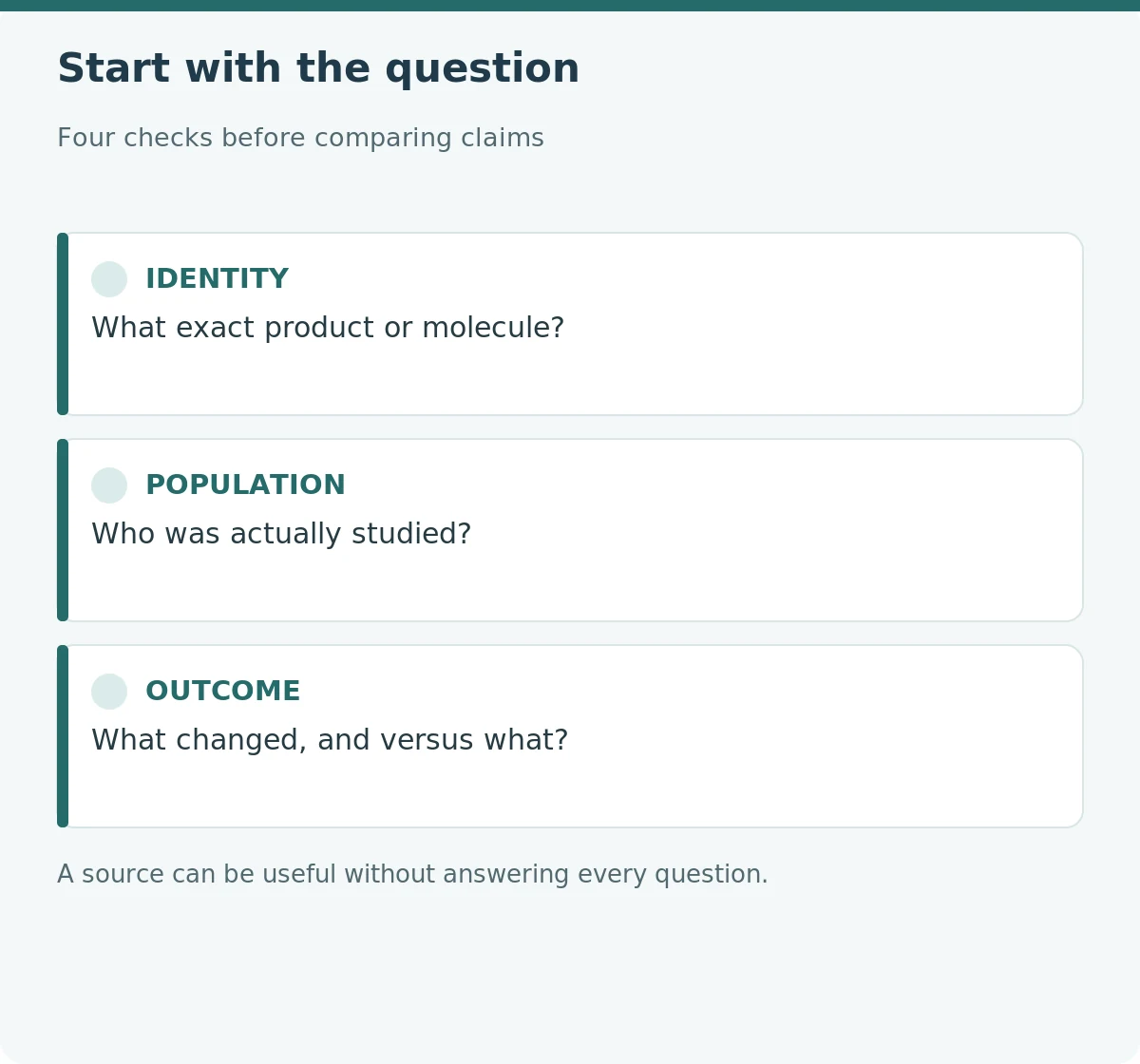
- Recognize the four jobs different sources can do
- Ask what the comparison group experienced
- Keep peer stories valuable without making them proof
- Separate product verification from clinical benefit
- Leave with a question that can actually be answered
What do you want to improve?
"Recovery" can mean recovering movement after a stroke, returning to work after an injury, sleeping more consistently, or rebuilding everyday routines. Those goals are important, but they are not interchangeable study outcomes. Write down the specific activity that is difficult and what a useful improvement would look like. That makes the next search much more precise than looking for a compound that promises general optimization.
For example, being able to finish a usual walk is different from seeing a laboratory marker change. Remembering appointments is different from scoring higher on an unfamiliar test. A useful article should state which of those results was actually assessed. When an advertisement moves between them without explanation, the reader is being asked to supply the missing evidence.
Give the compound an exact identity
A peptide is a chain of amino acids, but the label does not tell you what a particular product does. A named mixture, an individual molecule, and a modified version of that molecule can require different evidence. The same applies to the form: a study involving one preparation does not establish that a tablet, spray, or differently formulated vial will have the same effect.
Start with the full name, ingredient description, manufacturer or research supplier, and product form. The Cerebrolysin guide explains why a named medicinal preparation should not be treated as a generic single-peptide powder. The MOTS-c overview separates a signal measured inside the body from the question of giving an external product.
| Information you have | What it helps establish | What it does not settle |
|---|---|---|
| A mechanism diagram | A proposed biological explanation | Whether people experience the advertised benefit |
| A human trial | Results in a defined population and setting | Identical results in a different population |
| A personal account | An individual experience and practical questions | The effect attributable to the product |
| A batch report | The measurements listed for a sample | Clinical efficacy or every aspect of quality |
Recognize the four jobs different sources can do
Laboratory work can investigate a mechanism. Animal studies can test a proposed effect in a controlled model. Human studies can measure outcomes in their particular participants. Personal accounts can describe what someone noticed and what mattered to them. A strong reading process uses each for its appropriate purpose rather than treating one as a replacement for another.
Consider the original MOTS-c metabolic research: the intervention findings concerned mice, alongside work identifying the peptide in biological material. The implication for a reader is limited but useful: an attractive metabolic mechanism is a reason to investigate a human question, not the answer to that question.
Evidence also has a direction. An observation can generate a hypothesis; a properly designed trial can test it. A page that moves straight from an explanation of a pathway to a promised improvement has skipped the crucial testing stage.
Ask what the comparison group experienced
Improvement during treatment is not the same as improvement because of treatment. A comparison group helps distinguish the added effect from the rest of the care being received. The most useful question is not simply whether participants improved, but whether the relevant outcome differed between the groups and by enough to matter.
A double-blind DSIP insomnia study illustrates that distinction: some objective signals appeared favorable, but the authors considered the overall short-term benefit weak. That is a more informative conclusion than selecting the best-sounding result and ignoring the rest. Our DSIP guide explores how different sleep measurements can point in different directions.
Keep peer stories valuable without making them proof
A personal account may reveal a question that a short clinical scale misses: whether a person could reconnect with friends, tolerate an appointment, or regain confidence with an everyday task. That experience deserves respectful attention. It still does not tell us what would have happened without the product, whether another change contributed, or how often other people had the same outcome.
Ask whether the account includes a baseline, the duration of observation, concurrent treatment, unwanted effects, and financial interests. Do not ask another person to disclose private records publicly. An honest description can say that someone noticed a change while also acknowledging uncertainty about its cause.
Avoid comparing your progress with a highlight reel. A post that reports only the best day is not a record of the whole experience. The review-reading guide gives a practical way to examine that missing context.
Separate product verification from clinical benefit
A laboratory report, manufacturer label, and clinical study answer different questions. A label identifies what is being offered. A batch report describes particular tests on a submitted sample. A study investigates a clinical or scientific question. None is a substitute for the other two.
When someone presents a purity percentage as proof of improved wellbeing, ask for the missing connection: which relevant human outcome was measured using that exact formulation? Conversely, a promising clinical paper does not authenticate an unrelated vial. The COA guide shows how to keep those tasks separate without dismissing either one.
Leave with a question that can actually be answered
A productive reading session should produce a specific next question rather than a longer shopping list. That question might be whether a trial included people with a similar condition, whether the result was still present at follow-up, or whether the advertised preparation matches the one described in the paper.
Keep the answer in three short fields: what is established, what is plausible but untested, and what would change your view. This approach leaves room for promising research while preventing certainty from accumulating faster than evidence. It also makes conversations with the people involved in your care more focused and less dependent on marketing language.
Questions readers ask
Does a natural peptide automatically make a product safe?
No. A naturally occurring substance and an externally supplied formulation are different questions. Identity, amount, route, manufacturing, and the people exposed all affect what evidence is needed.
Can a negative study still be useful?
Yes. It can narrow a claim, show which outcome did not improve, and clarify what a future study would need to test. It should not be ignored because the result is inconvenient.